A well-wrapped burger should arrive intact, warm, and easy to handle. The method is simple, but the details matter: paper size, fold direction, and how tightly the wrapper hugs the bun. The National Restaurant Association’s 2024 State of the Restaurant Industry report projected U.S. restaurant sales of $1.1 trillion and employment of 15.7 million. That scale makes dependable service routines valuable, though a sales forecast alone cannot prove that one wrapping method works best. Small details matter.
This guide explains how to wrap a burger with food grade paper, from choosing a suitable sheet to securing the final fold. Use paper labeled for food contact, and keep clean hands and work surfaces away from ready-to-eat ingredients. A neat fold can limit leaks and help hold the burger together, but it cannot replace safe temperature control. The USDA Food Safety and Inspection Service identifies 40°F to 140°F as the temperature danger zone for perishable foods. Wrapping is not a safety fix. For hot holding, follow applicable food-safety guidance and your operation’s procedures. Expect a little practice: cheese, sauce, and an uneven bun can make an otherwise tidy wrap slip. The steps ahead focus on a practical, repeatable fold, while leaving room for the real-world mess of a busy counter.
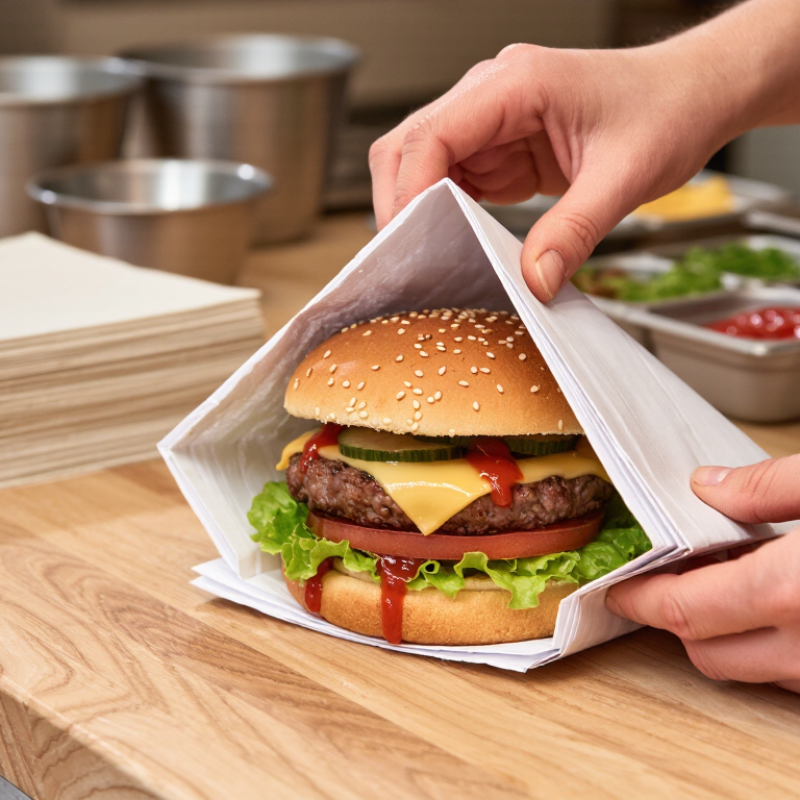
Choosing food-grade paper starts with the burger, not its color. A hot patty releases grease and steam, so the wrapper must resist both without becoming soggy. Ask the supplier for documentation covering direct food contact, fatty foods, temperature, and contact time. In the United States, FDA regulation 21 CFR 176.170 addresses certain paper and paperboard components used with aqueous and fatty foods. A label alone is not enough.
Check the paper beside a freshly cooked burger. Fold it around the patty, then look for seepage at the corners and soft spots along the seam. Grease-resistant treatments can help, but their suitability depends on the food and conditions. Avoid assuming every coating is interchangeable. That assumption is easy to make.
Sustainability claims also need context. The U.S. Environmental Protection Agency reported a 68.2% recycling rate for paper and paperboard overall in 2018; that figure does not describe greasy burger wrappers. Local programs may reject food-soiled packaging. Brown paper can look reassuring. Looks are not evidence. Compare supplier specifications, and confirm whether the finished wrapper can be recycled or composted where customers actually dispose of it.
| Selection Factor | What to Check | Practical Guidance |
|---|---|---|
| Food-contact suitability | Confirm that the paper and any coating are intended for direct food contact and suitable for the food’s temperature and fat content. | Request the supplier’s food-contact documentation for the intended use. Requirements vary by market; in the United States, applicable FDA requirements may apply, while the European Union has its own food-contact rules. |
| Paper type | Common options include uncoated kraft paper, grease-resistant paper, and paper with a food-contact coating. | Choose grease-resistant paper for juicy or oily burgers. Uncoated kraft paper may suit drier foods but can absorb grease and soften during service. |
| Basis weight | Basis weight is usually stated in grams per square metre (gsm). Burger wrapping papers are available in a range of weights, often around 30–60 gsm, depending on construction and intended use. | Treat gsm as a comparison point, not a guarantee of strength or grease resistance. Check a sample with your burger, fillings, and serving time. |
| Grease resistance | Check product specifications or test a sample for oil penetration, staining, and softening. | Test with a warm, fully assembled burger and allow it to sit for the expected holding time. A paper’s appearance alone does not confirm its grease-barrier performance. |
| Heat and moisture | Consider the burger’s serving temperature, steam, sauces, and how long it will remain wrapped. | Follow the paper supplier’s temperature limits. Wrapping very hot food tightly can trap steam, making the paper damp and the bun softer. |
| Sheet size | Choose a sheet large enough to cover the burger and overlap securely without excessive loose paper. | Measure the burger’s width and height, then test a few sheet sizes. A square sheet is convenient for a basic parcel wrap; larger burgers may need a larger sheet. |
| Prints, inks, and coatings | For printed paper, confirm that inks and coatings are suitable for the intended food-contact application. | Use the documented food-contact side as directed. Do not assume that every printed or coated paper is suitable for direct contact with greasy or hot food. |
| Basic wrapping method | Place the burger near the centre of the sheet, fold one side over it, tuck the opposite side underneath, then fold the open ends inward. | Keep the wrap snug enough to hold the burger together but not so tight that the bun is crushed. Use a food-safe sticker or label if extra closure is needed. |
| Disposal and recycling | Food residue and grease can affect recycling, and some barrier coatings may change local disposal options. | Check local waste guidance and the paper’s disposal information. Do not describe a wrap as recyclable or compostable unless its construction and local facilities support that claim. |
Check that it is intended for direct food contact. Ask for documentation covering fatty foods, heat, and contact time.
Wrap a freshly cooked burger and inspect the corners and seam. Look for grease seepage or soft spots.
No. Suitability depends on the food and wrapping conditions. Don’t assume every coating performs the same way.
No. Local recycling programs may reject food-soiled paper. Check local guidance before making a recycling claim.
Set it slightly below the center of a square, toasted bun facing up. Leave room for folds on every side.
Lift the near edge over the burger and tuck it beneath the bun. Fold both side corners inward, then roll the burger until the seam rests underneath.
Keep it snug, not tight. Pressure can push sauce through the paper and crush the bun.
Food-safety guidance recommends 160°F (71°C). Check the patty with a food thermometer; wrapping does not make undercooked beef safe.
Try a slightly larger sheet and wipe sauce from the paper edge. My first fold isn’t always neat; forcing it usually makes things worse.
Learning how to wrap a burger with food grade paper starts with choosing a clean, grease-resistant sheet that is large enough to cover the burger without tearing. Before wrapping, prepare the burger and a dry, clean surface. Place the paper flat with one corner pointing toward you, then set the burger near the center so there is enough paper on every side to fold securely.
Bring the near corner up and over the burger, gently tucking it beneath the sandwich to hold the fillings in place. Fold in the side corners, then roll the burger forward until the paper forms a snug package. Avoid pulling so tightly that the bun is crushed. Tuck the final edge under the wrapped burger or use a small piece of food-safe tape to keep the paper closed. Serve it right away, or place it in a suitable container for short-term storage.

 PsiPrime Packaging