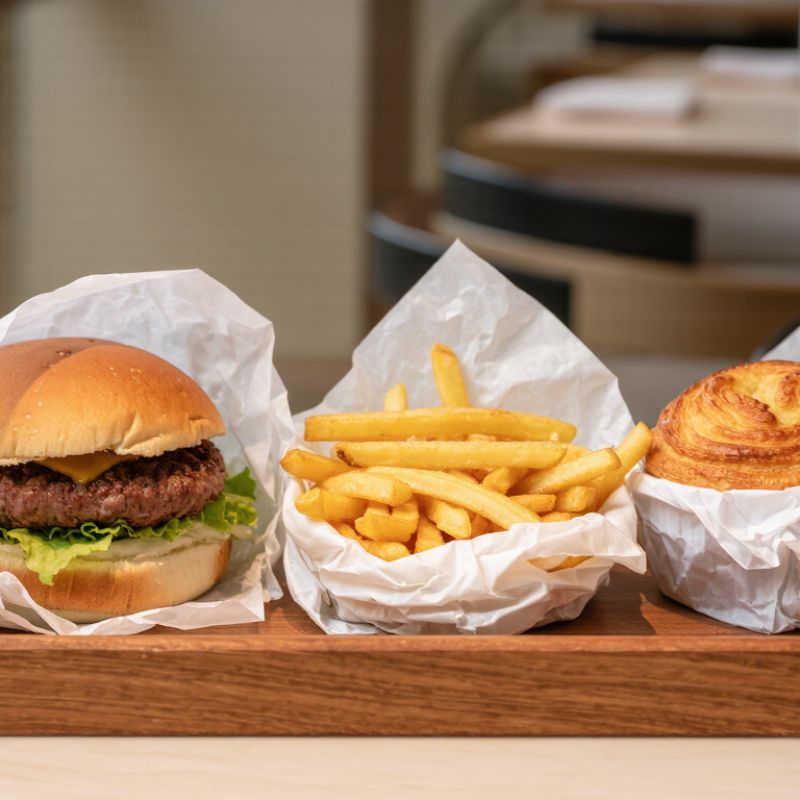
Restaurants serve burgers in paper sleeves, fries in lined trays, and pastries in folded bags. These small choices affect handling, presentation, and cleanup. The National Restaurant Association’s 2024 State of the Restaurant Industry report says nearly 75% of restaurant traffic is off-premises. That makes dependable wrapping important. Still, a wrapper is only one part of the service experience.
So, why do restaurants use greaseproof wrapping paper? It helps limit visible oil marks, keeps food easier to hold, and can support a neat takeaway presentation. China is a major sourcing option because manufacturers may offer varied sheet sizes, printing, and order volumes. But origin alone proves nothing. Buyers should check grease resistance, paper weight, food-contact documentation for the intended market, and consistency between production batches. Ask for samples. Test them with your own menu.
The wider market gives useful context, not a paper-specific answer. Fortune Business Insights estimated the global food packaging market at US$456.1 billion in 2023. That broad category includes many formats, so it should not be mistaken for greaseproof-paper demand. Cost matters, too, but the cheapest sheet can disappoint if it softens under hot, oily food. A practical sourcing review compares performance, lead time, print quality, and total landed cost. Small details matter. I would also retest after changing suppliers; paper that looked fine with a dry pastry may behave differently around a freshly fried item.
What Greaseproof Paper Does: Cellulose Fibers, Grammage, and ISO 536
Why Do Restaurants Use Top Greaseproof Paper from China?
Grease resistance begins with the sheet’s structure. Cellulose fibers form a dense web, and refining can help close spaces between fibers. This slows oil penetration, but it does not make every sheet equally resistant. A hot, oily dumpling can reveal weak spots quickly. Small differences matter.
Grammage describes paper mass per unit area, measured in grams per square metre (g/m²). ISO 536:2019 specifies how to determine this property; TAPPI T 410 provides a related industry test method. For example, a 100 cm² sample weighing 0.50 g corresponds to 50 g/m². That figure describes weight, not grease resistance by itself. Fiber composition, sheet formation, and any treatment also affect performance.
Restaurants sourcing greaseproof paper from China can compare supplier test reports using consistent methods. Check the stated grammage, test conditions, and whether results apply to the finished sheet. A thicker sample may feel sturdier, yet still absorb oil if its fiber network is less effective. Ask for samples and test them with the foods actually served: fried pastries, oily noodles, or warm sandwiches. A paper that performs well at room temperature may behave differently under heat. That detail is easy to overlook.
How Grease Resistance Is Rated: TAPPI T 559’s 1–12 Kit Scale
Why Do Restaurants Use Top Greaseproof Paper from China?
TAPPI T 559 gives buyers a practical way to compare a paper’s resistance to grease. In this test, numbered “kit” liquids are applied to the sheet’s surface under controlled conditions. The scale runs from 1 to 12. A higher passing number generally indicates stronger resistance to the test liquids.
The result is the highest-numbered liquid that does not visibly stain or darken the paper during the specified test. Small details matter: sample conditioning, surface differences, and consistent application can affect readings. A score is useful, but it is not a promise that paper will perform identically with every food, temperature, or contact time. Real kitchens vary.
For restaurants sourcing greaseproof paper from China, request the TAPPI T 559 result alongside intended-use details. Ask whether the tested sample matches the supplied grade, and check how the paper behaves with oily foods after normal handling. A high number can still mislead if the test conditions are unclear. Not the whole story. A simple side-by-side trial with a hot pastry or fried snack can reveal practical issues, such as staining at folds or grease creeping through thin spots.
Food-Contact Rules: FDA 21 CFR 176.170 and EU Regulation 1935/2004
Why Do Restaurants Use Top Greaseproof Paper from China?
Food-contact compliance matters as much as grease resistance. FDA 21 CFR 176.170 covers certain paper and paperboard components used with aqueous and fatty foods, subject to specified conditions. It does not mean every greaseproof sheet is suitable for every food or use. In the EU, Regulation 1935/2004 sets general requirements: materials should not transfer substances in amounts that could endanger health, unacceptably change food, or affect its taste or smell. Traceability is also important. Ask suppliers for specifications and supporting compliance documents, and check that they match the food type, contact time, and temperature. A document alone is not proof that a sheet suits every kitchen.
Tips: Before ordering, describe the real use: hot fries, oily pastries, or room-temperature sandwiches. Request applicable test information and intended-use conditions. Check the sheet against your menu, not just its appearance.
Chinese manufacturers may offer varied sheet sizes, coatings, and order volumes, which can help restaurants compare practical options. Still, origin does not establish compliance. A paper that performs well with a dry bun may behave differently beside hot, fatty food. If results or documentation are unclear, pause and ask for clarification; this step can feel slow, but guessing is worse. Keep supplier records and review them when materials or recipes change.
Why Chinese Suppliers Compete: Custom Formats and ISO 9001 Quality Controls
Restaurants need greaseproof paper that fits the food, tray, and service routine—not just a standard sheet. Chinese suppliers often offer custom sheet sizes, roll widths, basis weights, and print layouts. A kitchen can specify paper for a basket of fried chicken or a narrow sandwich wrap. Fit matters. Smithers’ The Future of Global Packaging to 2028 valued the global packaging market at more than US$1 trillion in 2023, reflecting the scale and variety of packaging demand. Customization can reduce trimming and improve handling, but buyers should confirm grease resistance with samples under real food conditions.
ISO 9001 adds a useful quality-management framework. The ISO Survey 2022 reported more than 1.2 million valid ISO 9001 certificates worldwide. For a paper supplier, documented procedures can support consistent specifications, batch records, corrective actions, and traceability. Still, a certificate is not a test result. It does not, by itself, prove that a paper resists oil or performs well with hot, moist food. Ask for product-specific test data, agreed tolerances, and inspection records alongside the certificate. One detail can be missed. Even careful suppliers may need to adjust a format after a restaurant tests it on a busy service line.
How Restaurants Choose Paper for Wrapping, Food Liners, and Takeaway Packs
Why Do Restaurants Use Top Greaseproof Paper from China?
Restaurants choose paper according to how food is served. A burger needs a liner that resists oil without sticking to a warm bun. Pastries may need a lighter sheet that keeps crumbs contained but still looks neat in a display case. For takeaway packs, sheet size and folding strength matter too. A wrapper that tears at the corners slows down service.
Tips: Test paper with your actual menu items. Check grease transfer, tearing, and how it feels after several minutes. Small details matter.
When comparing suppliers in China, ask for samples in the exact size and paper weight you expect to order. Test them with hot, oily, and moist foods; one paper may perform differently across dishes. Request clear specifications for material, coating, and printing, and confirm that documentation matches the product supplied. Consistent quality depends on more than a low unit price. It also helps to check whether packaging arrives clean, dry, and protected. A sample can look convincing, yet daily kitchen use may reveal problems. That is worth questioning before placing a large order.
Why Restaurants Choose Greaseproof Paper: Key Requirements by Use
How to read this chart: Ratings show relative performance priorities on a 1–5 scale, where 5 means a higher priority. They are an illustrative comparison, not survey results or product test scores. Restaurants should verify that any paper—including paper sourced from China—is suitable for its intended food contact and complies with applicable regulations.
Conclusion
Restaurants use greaseproof paper to help keep oils and sauces from soaking through, while maintaining a clean, convenient way to serve and package food. Its performance depends on factors such as cellulose fiber composition and grammage, which can be measured using ISO 536. Grease resistance may also be assessed with the TAPPI T 559 kit scale, ranging from 1 to 12, helping buyers compare papers for different foods and handling needs.
When asking why do restaurants use greaseproof wrapping paper, the answer often comes down to practical performance, food-contact suitability, and fit for purpose. Buyers can check whether materials meet applicable requirements, including FDA 21 CFR 176.170 or EU Regulation 1935/2004, as relevant to their market. Chinese suppliers may offer custom sizes and formats, supported by ISO 9001 quality controls. Restaurants can then select suitable paper for wrapping, lining trays or baskets, and assembling takeaway packs, balancing grease resistance, strength, and ease of use.

 PsiPrime Packaging