Compostable vs Biodegradable Food Packaging Which Is Better?

Time:2026-11-04 Author:Sienna
0%

A takeaway bowl may look green, yet its end-of-life story depends on more than its label. The question “what is the difference between compostable and biodegradable food containers” matters to restaurants, buyers, and anyone sorting waste at home. One term points toward specific composting conditions; the other can describe a much broader process.

The OECD’s Global Plastics Outlook reported that the world generated 353 million tonnes of plastic waste in 2019, and only 9% was recycled. Food packaging is part of that difficult stream. “Biodegradable” alone does not tell shoppers how quickly a container breaks down, where it will do so, or whether it leaves residue. Compostable products are designed to break down under defined composting conditions, often in industrial facilities. A home compost bin may not provide enough heat or moisture.

Polymer scientist Ramani Narayan captures a key distinction: “Biodegradability is a system property, not a material property.” That is useful, but it does not settle every purchasing decision. Certification, local composting access, food-soiling, and disposal instructions all matter. A certified container can still be misplaced in a landfill. Labels can confuse. This guide compares the terms, the evidence behind them, and the practical trade-offs for food businesses and consumers. It also asks a less comfortable question: does a better material help when the right disposal route is missing?
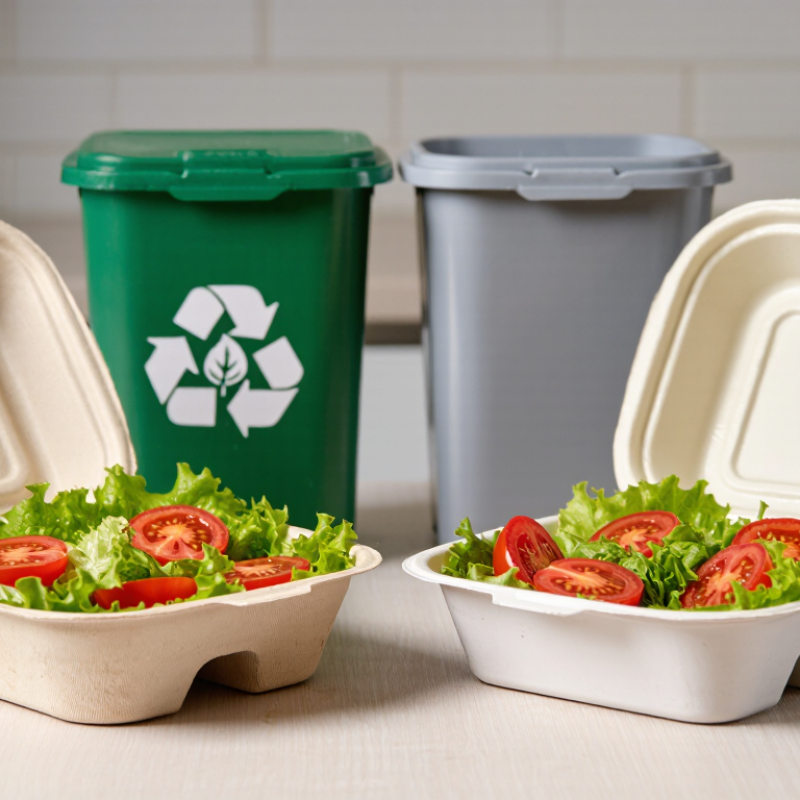
Compostable vs Biodegradable Food Packaging Which Is Better?

Defining Compostable and Biodegradable Packaging by Their End-of-Life Claims

“Compostable” is an end-of-life claim: under specified conditions, packaging should break down into compost without leaving harmful residues. Those conditions matter. A package designed for an industrial composting facility may need controlled heat, moisture, and processing time. It may not break down in a backyard pile.

“Biodegradable” means microorganisms can break material down, but the word alone does not say how quickly or where. It may not identify whether the package will degrade in soil, water, or a managed composting system. That distinction matters. A takeaway tray marked “biodegradable” could persist when discarded in a dry landfill, where oxygen and microbial activity may be limited. Not in every bin.

Check the full claim, not just the front-of-pack wording. Look for stated disposal conditions and credible certification details, then check whether local collection accepts that material. A compostable cup can still contaminate recycling if placed in the wrong stream. Even a well-defined claim has limits: actual breakdown depends on the facility and its process. “Biodegradable” without a timeframe or disposal setting leaves important questions unanswered.

ASTM D6400 Requires 90% Biodegradation Within 180 Days

ASTM D6400 is often reduced to one headline: 90% biodegradation within 180 days. More precisely, the test measures how much a plastic’s organic carbon becomes carbon dioxide under controlled, aerobic composting conditions, compared with a reference material. It does not mean every fork or film vanishes completely in six months.

Conditions matter. Industrial composting uses managed heat, moisture, and airflow. A cool backyard pile may not provide the same environment, even when packaging meets the standard. D6400 also evaluates other factors, including material breakdown and effects on compost quality. Passing one test threshold alone does not tell the whole story.

That distinction helps when comparing compostable and biodegradable packaging. “Biodegradable” can describe breakdown without specifying a timeframe or disposal setting. A D6400-based claim is more specific, but buyers should still check whether local composting facilities accept the item. A rigid cup may meet testing requirements yet be rejected if a facility cannot sort it. I would not treat the 90% figure as a promise about what happens in every bin; it is a result tied to defined test conditions. The wording is useful, but easy to oversimplify.

ASTM D6400 Limits 2-mm Sieve Residue to 10% After 12 Weeks

“Compostable” and “biodegradable” are not interchangeable.

ASTM D6400 sets a measurable disintegration benchmark for plastics intended for industrial composting: after 12 weeks, no more than 10% of the original dry mass may remain on a 2-mm sieve. That checks particle size, not complete breakdown. A small fragment can pass through the sieve without having fully converted into carbon dioxide, water, and biomass. Small detail. Big consequence. D6400 also addresses biodegradation, metals, and plant toxicity under controlled test conditions; those results do not guarantee the same outcome in every composting facility.

Facility conditions matter. Food scraps, moisture, heat, and turning practices affect what a compost site can process. The US Environmental Protection Agency’s 2019 Wasted Food Report estimated that 66 million tons of wasted food came from retail, food service, and residential sources.

Packaging that can be identified and accepted alongside food scraps may help keep organics out of landfill, but local facility rules still decide what belongs in the bin. Check whether the finished package—not just its raw material—has been tested to the relevant standard. And be candid: a sieve result is useful, but it is not a complete picture of real-world composting.

Industrial vs. Home Composting: Match Packaging to Certified Conditions

Industrial and home composting are different test environments. A package marked “compostable” may not break down in a backyard pile. Match the certification to the conditions your waste processor actually uses.

Industrial composting

ASTM International’s D6400 standard sets industrial-composting benchmarks: at least 90% biodegradation within 180 days, plus disintegration testing over 12 weeks. These are controlled test conditions, not a promise that every facility accepts the item. EPA’s 2018 materials report estimated that just 2.6 million tons, or 4.1%, of U.S. wasted food was composted. Access and collection remain uneven. Check with the local processor before choosing packaging.

Home composting

Home-compost certifications assess performance under cooler, less consistent conditions; look for a specific home-compost label, not a generic “biodegradable” claim. A damp pile, dry leaves, and winter temperatures can all change the result. That gap is easy to miss. Even certified packaging may be screened out if a facility is not equipped to process it. For food service, confirm the exact certification and accepted items with both the packaging supplier and compost operator. A label helps, but the local bin decides.

Compare Certification, Local Composting Access, and Food-Service Needs

Compostable and biodegradable sound similar, but they describe different outcomes. “Biodegradable” alone may not specify how quickly packaging breaks down or what conditions it needs. A recognized compostability certification gives buyers clearer test criteria, yet it does not guarantee acceptance by every composting facility. Check the certificate’s scope and ask whether it covers the finished item, including inks and coatings. Small print matters.

Local access can decide whether compostable packaging is useful. Some facilities accept food scraps and certified packaging; others accept food scraps only. A café with no collection service may send used cups to landfill, even when the cups carry compostable claims. Call the local hauler before ordering. It is an awkward step, but often overlooked. Confirm what happens to lids, liners, and food-soiled items, too.

Food-service needs are equally practical. A bowl must hold a hot, oily meal without leaking during a ten-minute delivery ride. Test packaging with the actual menu, serving temperature, and storage conditions. Staff also need simple sorting instructions near bins; confusing labels can contaminate a whole load. I would not choose by material claims alone. Cost, reliable supply, and a realistic disposal route all shape the result, and that balance can be harder than it looks.

Compostable vs. Biodegradable Food Packaging: Which Is Better? Compare certification, local composting access, and food-service needs

Comparison factor Certified compostable packaging Packaging described as biodegradable Practical takeaway
What the term means Designed to break down in a defined composting process and meet specified requirements for disintegration, biodegradation, and other impacts. Means that material can be broken down by microorganisms under some conditions; by itself, the term does not specify a timeframe, environment, or residue standard. “Biodegradable” alone is not a reliable disposal instruction or proof that packaging will break down in a local waste system.
Certification to look for In the United States, check for certification against ASTM D6400 for compostable plastics or ASTM D6868 for certain paper or fiber products with plastic coatings or additives. EN 13432 is a commonly used European standard. A general claim may not identify an independent test, applicable standard, or whether the product is intended for composting, soil, or another environment. Verify the exact product and certification scope; certification of a material or one component does not automatically cover every part of an assembled package.
Composting conditions Many certified food-service items are intended for industrial or commercial composting, where managed heat, moisture, oxygen, and processing time support breakdown. The conditions and speed of breakdown can vary substantially. A biodegradable claim does not establish that an item will break down in a landfill, in the open environment, or in a home compost pile. Do not assume industrially compostable packaging is suitable for home composting unless the product is specifically tested and labeled for that use.
Local collection and processing Useful only when a local organics program or commercial composting facility accepts the specific item. Acceptance rules differ, and some facilities exclude compostable food-service packaging. Usually does not establish an accepted collection route. It may be rejected from organics streams and can be mistaken for conventional plastic in sorting systems. Ask the hauler or facility which certified products it accepts before purchasing or labeling items for compost collection.
Food-service performance Available in formats such as food-contact cups, trays, cutlery, and takeout containers. Heat, moisture, grease resistance, and shelf life depend on the specific material and product design. The term does not indicate whether an item is safe for its intended food contact or suitable for hot, wet, oily, or long-duration service. Evaluate food-contact compliance and real-use performance separately from end-of-life claims.
Contamination and sorting Can help collect food scraps with packaging where a facility accepts both. If not accepted, it may contaminate recycling or organics loads. Ambiguous labeling can lead customers to place items in the wrong bin; biodegradable plastics are not necessarily compatible with conventional recycling. Use clear, locally accurate bin instructions and train staff to keep packaging out of streams that do not accept it.
Best fit A stronger option when the product is appropriately certified, meets service requirements, and a confirmed local composting route accepts it. A claim that needs further evidence and specific disposal instructions before it can guide a food-service purchasing decision. Neither label is automatically “better” everywhere; local infrastructure and the actual product determine the practical choice.

Decision rule: Choose certified compostable packaging only when your local facility confirms acceptance and your staff can separate it correctly. Otherwise, consider reusable systems or packaging compatible with the waste services available in your area. Certification and local acceptance should be checked for the specific finished product.

FAQS

What does the 90% biodegradation figure mean?

It means at least 90% of a plastic’s organic carbon becomes carbon dioxide within 180 days under controlled, aerobic industrial composting conditions. It is not a guarantee that every item disappears in six months.

Does compostable packaging always break down in a backyard pile?

No. Backyard piles are often cooler and less consistent than industrial composting systems. Moisture, airflow, and winter temperatures can all affect breakdown.

What does the 12-week sieve test measure?

After 12 weeks, no more than 10% of the original dry mass may remain on a 2-millimeter sieve. Small fragments can pass through without fully breaking down. That distinction matters.

Is “biodegradable” the same as “compostable”?

No. “Biodegradable” may not specify a timeframe or disposal setting. Compostability claims relate to defined conditions and testing, but the wording can still be oversimplified.

Does passing a compostability test mean a facility will accept the packaging?

No. A facility may reject an item if it cannot identify or sort it. Check with the local compost operator before putting packaging in the collection bin.

What other factors are assessed besides biodegradation?

Testing can assess physical disintegration, metals, and effects on compost quality or plant growth. One passing result alone does not describe the whole outcome.

How can I check whether packaging suits my composting setup?

Look for a certification matching industrial or home composting conditions. Then confirm that your local processor accepts the finished package, not just its raw material. Labels are helpful, not decisive.

Why does facility access matter for food packaging?

Food scraps, moisture, heat, and turning practices affect what a site can process. A package may seem suitable, yet still be screened out. That gap is easy to miss.

Conclusion

Compostable and biodegradable food packaging make different end-of-life claims. Biodegradable means a material can be broken down by microorganisms, but the claim alone may not specify how quickly or under what conditions. Compostable packaging is intended to break down in composting conditions without leaving harmful residues. So, what is the difference between compostable and biodegradable food containers? Compostable products make a more specific promise about their disposal environment, while “biodegradable” by itself can be too broad to guide consumers.

For industrially compostable packaging, ASTM D6400 sets performance criteria that include at least 90% biodegradation within 180 days and no more than 10% residue larger than 2 mm after 12 weeks. These conditions are not the same as home composting, so packaging should match the facilities available locally and the conditions stated in its certification. Food-service operators should also consider collection access, disposal instructions, and practical needs such as handling food waste. The most suitable option is one whose certified end-of-life conditions can actually be met.

Sienna

Sienna

Sienna is a skilled marketing professional with a deep expertise in our company’s core products and services. With a passion for innovation and detail, she plays a pivotal role in crafting insightful blog posts that not only highlight the unique features of our offerings but also provide valuable......